
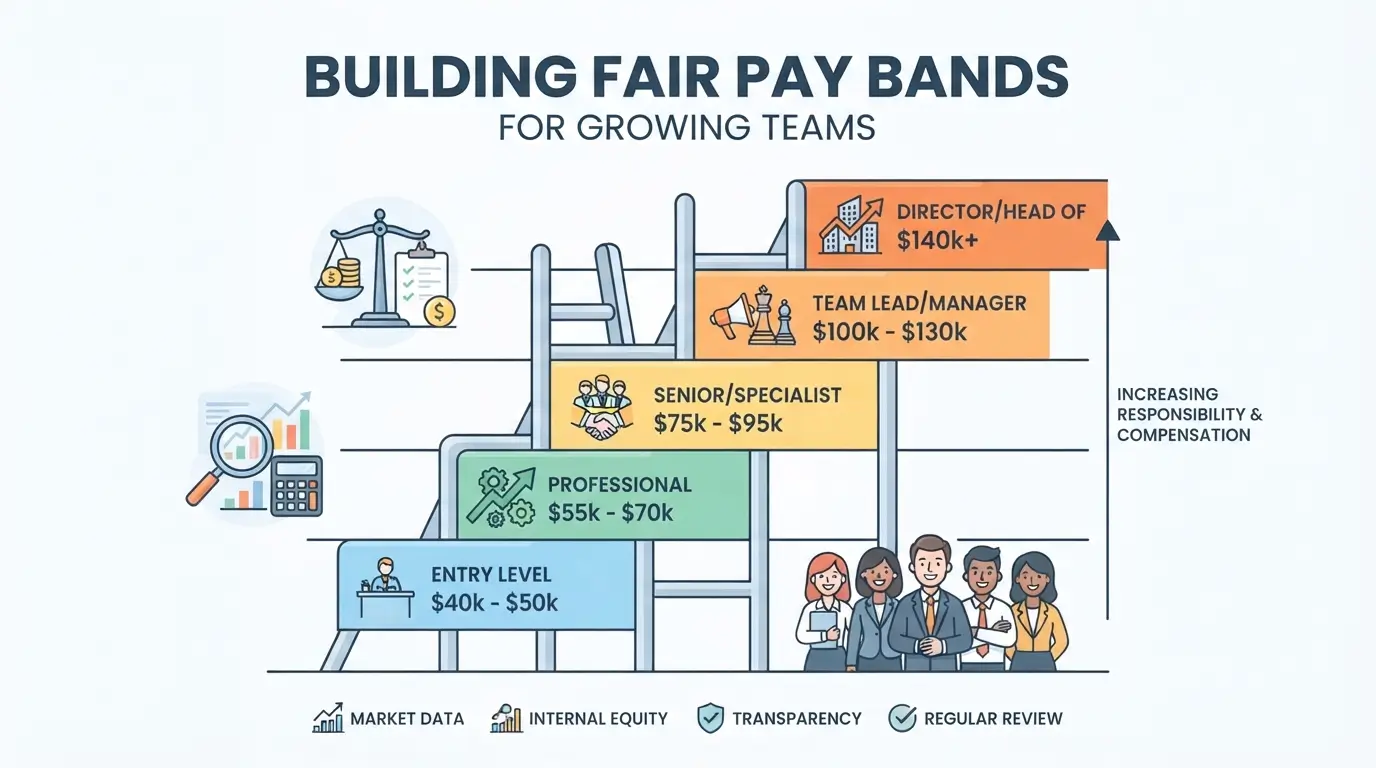
Key Takeaways
- Pay bands create a consistent framework for hiring, promotions, and salary adjustments.
- Strong ranges account for role scope, level, location, skills, market conditions, and internal equity.
- Market data should inform decisions, not replace judgment about the work employees actually perform.
- Managers need clear guidance on how employees are placed within a range.
- Regular reviews help pay structures remain useful as business needs and labor markets change.
As a company grows, informal compensation decisions become harder to manage. What worked when a founder negotiated every offer can produce confusion when several managers are hiring, promoting, and retaining employees across different teams.
A clear pay structure gives those decisions a common starting point. Understanding what is the salary range helps employers set practical boundaries around what they can pay while giving employees a clearer view of how compensation relates to role, level, and responsibility. A consistent approach can also make compensation discussions easier to explain and maintain over time. It gives managers a shared framework for making pay decisions as the organization continues to grow
Why Pay Bands Matter As Teams Grow
Pay bands help managers make similar decisions for similar work. Without them, two employees with comparable responsibilities may receive very different offers simply because they were hired at different times or negotiated with different managers. A documented structure also improves budgeting because leaders can see the expected compensation range for planned roles before opening them.
Salary Range Vs. Pay Band
A salary range is the minimum-to-maximum base pay an employer is prepared to offer for a particular role. A pay band can apply to one role, several closely related jobs, or a broader career level. Both typically include a minimum, a midpoint, and a maximum. The midpoint is a planning reference for the organization, not an automatic entitlement for every employee.
What Shapes A Pay Band
Start with the work itself rather than the job title. Two roles with the same title can carry very different levels of responsibility.
- Job scope:Decision-making authority, technical difficulty, and business impact.
- Career level:Entry, experienced, senior, manager, and leadership expectations.
- Location:Local labor conditions when geography affects recruiting and pay practices.
- Skills and industry:Required certifications, specialized expertise, and sector-specific demand.
- Company stage:Budget, growth plans, and the broader mix of salary, incentives, benefits, or equity.
- Internal equity:How a proposed range compares with employees performing comparable work.
How To Build Pay Bands Step By Step
- List roles by job family, department, level, and relevant location.
- Write role profiles that describe responsibilities, outcomes, and required capabilities.
- Collect several relevant data points, such as compensation surveys, accepted offers, and recent recruiting results.
- Choose a market position that fits the company’s compensation philosophy and budget.
- Set a midpoint, then establish minimum and maximum pay that allow for appropriate growth in the role.
- Check that adjacent levels progress logically and do not create artificial ceilings.
- Compare current employee pay with the draft structure before using it for new offers.
- Document exceptions, including the business reason and required approval.
How To Use Market Data Without Losing Internal Fairness
One salary website or survey should not determine an entire compensation structure. Compare roles by function, level, location, organization size, and industry where possible. Keep base salary separate from bonuses, commissions, equity, and benefits so that they are not treated as interchangeable.
For example, an external benchmark may indicate that a specialized new hire should be paid near the top of a range. Before making that offer, review whether current employees with comparable scope and stronger institutional knowledge are paid consistently. Record the data sources, dates, and assumptions used so later reviews can explain how the decision was made.
Pay Transparency And 2026 Hiring Practices
Pay transparency makes accurate ranges more important. In Virginia, the law that took effect on July 1, 2026, requires good-faith pay ranges in internal and external job postings and restricts reliance on applicants’ salary history. The University of Virginia’s guidance on pay transparency requirements for job postings illustrates why recruiters and managers need shared processes before a role is advertised.
A posted range should reflect a realistic hiring budget, not a broad span designed to avoid a decision. Align job-posting ranges with internal bands, and prepare managers to explain how relevant skills, experience, scope, and location influence placement. Employers should also confirm the rules that apply in every state and locality where they hire.
Common Pay Band Mistakes To Avoid
- Using titles as the only basis for compensation decisions.
- Copying market data without checking the actual scope of the role.
- Making ranges so wide that they provide little practical guidance.
- Ignoring employees paid below a newly established minimum.
- Allowing undocumented manager exceptions.
- Publishing ranges that do not match likely offers or approved budgets.
How Often To Review Pay Bands
Conduct a full review at least annually, with smaller checks before merit cycles or significant hiring periods. Fast-moving roles may need closer monitoring. Revisit ranges early when offer declines increase, turnover rises, labor demand changes, an acquisition alters job scope, or repeated exceptions suggest that a band no longer fits the work.
Recent changes to Virginia job-posting rules show why compensation systems require ongoing maintenance. Track range penetration, compa-ratio, offer acceptance, turnover, and pay-equity findings to identify where adjustments may be needed.
Common Questions About Pay Bands
How Wide Should A Pay Band Be?
There is no single correct width. The right spread depends on job complexity, expected development within the role, market movement, and the difference between adjacent levels.
Should Every Employee In The Same Role Earn The Same Pay?
Not necessarily. Differences can be appropriate when they are based on job-related factors such as scope, relevant skills, experience, performance, or location. The rationale should be consistent and documented.
What Happens When Someone Is Below The Minimum?
Review the employee’s responsibilities, performance, and history. If the employee meets the role requirements, create a defined plan to address the gap.
Can A Company Pay Above The Maximum?
Exceptions may be justified by rare skills, expanded duties, retention needs, or temporary market pressure. They should be approved and recorded rather than handled informally.
Conclusion
Fair pay bands are practical decision tools, not rigid promises. The most durable structures combine clear job levels, reliable market inputs, internal consistency, documented exceptions, and regular reviews. When employees and candidates understand how pay decisions are made, compensation becomes easier to manage and trust.
 Hamza
Hamza