


What Is One-Way Video Interview Software?
Hiring has evolved significantly over the past decade. Remote work, distributed teams, and higher application volumes have made traditional phone screens and first-round interviews increasingly difficult to manage. Recruiters are expected to evaluate more candidates in less time while still delivering a professional candidate experience.
This is where one-way video interview software has become an essential recruitment technology.
Unlike a live interview, one-way video interview software allows recruiters to create a structured set of interview questions that candidates answer by recording video responses whenever it is convenient for them. There is no need to coordinate calendars or arrange meeting times. Recruiters simply review the completed interviews later, compare responses consistently, and decide which candidates should move forward in the hiring process.
You may also hear one-way video interviews referred to as:
- Asynchronous video interviews
- Pre-recorded video interviews
- On-demand video interviews
Although the terminology varies, the concept remains the same: recruiters and candidates participate at different times instead of meeting live.
Rather than replacing human interaction, one-way video interviews improve the earliest stage of recruitment by eliminating repetitive screening calls while giving recruiters more meaningful insights than a résumé alone can provide.
Today, organizations of every size—from startups to multinational enterprises—use one-way video interview software for graduate recruitment, customer service, sales, retail, healthcare, hospitality, and remote hiring, where managing large applicant volumes efficiently is a priority.
Why Traditional Phone Screening Is No Longer Enough
For years, phone interviews were the standard method for screening candidates before inviting them to formal interviews. While this approach still has value, it becomes increasingly difficult as hiring volumes grow.
Recruiters often spend hours every week:
- Coordinating interview schedules
- Rearranging missed appointments
- Asking the same introductory questions repeatedly
- Taking manual interview notes
- Comparing candidates from memory
These repetitive administrative tasks reduce the time available for evaluating talent and engaging with the strongest applicants.
Candidates also experience challenges. Many already have full-time jobs, live in different time zones, or have personal commitments that make scheduling difficult. Missing a single phone interview can delay the hiring process or create unnecessary stress.
One-way video interview software removes these scheduling bottlenecks by allowing candidates to complete interviews before a deadline while enabling recruiters to review responses whenever their schedule permits. This asynchronous approach creates a more flexible process for everyone involved without sacrificing interview quality.
How One-Way Video Interview Software Works
Although each platform offers different features, the overall workflow follows the same structured process.
Step 1. Create the Interview
Recruiters begin by creating an interview designed specifically for the role.
Depending on the software, they can:
- Add text or video interview questions
- Define preparation time
- Set response time limits
- Allow or restrict re-recording
- Choose mandatory or optional questions
- Create reusable interview templates
Standardized interview templates help ensure every applicant receives the same questions, making evaluations more consistent and objective.
Step 2. Invite Candidates
Once the interview is ready, recruiters send candidates a secure interview link via email.
Instead of choosing an interview time, candidates simply complete the interview whenever it is convenient before the submission deadline.
Most modern platforms support:
- Desktop browsers
- Smartphones
- Tablets
This flexibility makes the interview process more accessible while significantly reducing scheduling conflicts.
Step 3. Candidates Record Their Responses
Candidates answer each question individually using their device’s camera and microphone.
Depending on the interview settings, they may be able to:
- Complete a practice interview
- Re-record selected answers
- Finish the interview across multiple sessions
- Submit all responses once complete
Because no interviewer is present, many candidates feel less pressured than they would during a live interview, often resulting in more natural and thoughtful responses.
Step 4. Recruiters Review and Evaluate
After candidates submit their interviews, recruiters receive a notification that responses are available for review.
Instead of conducting interviews one after another, hiring teams can:
- Watch recordings at any convenient time
- Pause or replay responses
- Compare candidates side by side
- Share interviews with hiring managers
- Leave structured feedback
- Score candidates consistently
This collaborative review process helps improve hiring decisions while maintaining a documented evaluation process that is easier to review later.
Why ScreeningHive Is Worth Considering
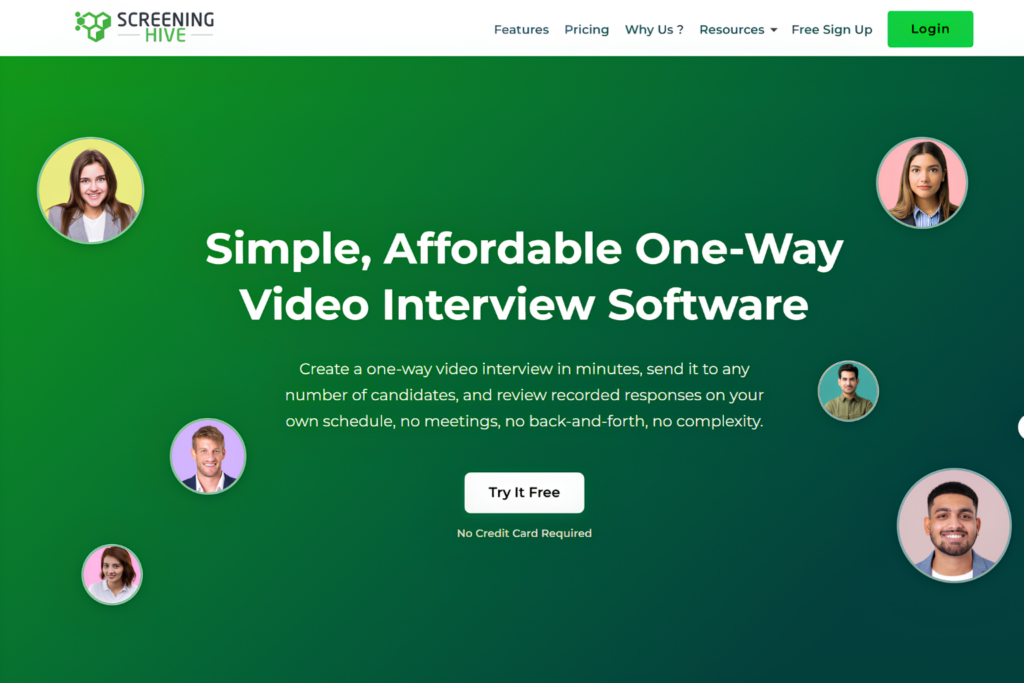
ScreeningHive is a cloud-based one-way video interview platform designed to simplify early-stage candidate screening without adding unnecessary complexity.
Recruiters can create structured interviews in minutes using reusable templates, text or video questions, customizable response settings, and automated invitation workflows. Candidates receive a secure interview link and can complete their interview from a desktop, tablet, or smartphone at a time that suits them.
The platform also includes practical features that support everyday recruitment, including bulk candidate invitations, practice interviews, retry controls, candidate scoring, collaborative team feedback, encrypted video recordings, automated reminders, and Open API integrations with Applicant Tracking Systems.
For hiring teams managing multiple vacancies, ScreeningHive removes the need for constant scheduling while creating a more consistent evaluation process. Recruiters can review recorded responses whenever convenient, compare candidates side by side, and share feedback with hiring managers before moving applicants to the next stage.
Candidates also benefit from a straightforward interview experience that is mobile-friendly and easy to complete without lengthy setup or complicated software installations.
Rather than trying to be an all-in-one HR platform, ScreeningHive focuses on doing one thing exceptionally well: helping organizations conduct structured one-way video interviews that save time, improve consistency, and create a better screening experience for everyone involved.
Key Features to Look for in One-Way Video Interview Software
Not every platform offers the same functionality. The best software goes beyond recording videos and provides tools that make recruitment more structured, collaborative, and efficient.
1. Structured Interview Templates
Reusable interview templates allow recruiters to launch interviews quickly while ensuring every candidate answers the same role-specific questions.
A standardized interview process also makes comparisons fairer and reduces unconscious bias during screening.
2. Bulk Candidate Invitations
Hiring multiple applicants individually can quickly become time-consuming.
Bulk invitation capabilities allow recruiters to send interview requests to dozens—or even hundreds—of candidates simultaneously, making the platform particularly valuable for high-volume recruitment.
3. Mobile-Friendly Experience
Many candidates now complete job applications using mobile devices.
A modern one-way video interview platform should work seamlessly across smartphones, tablets, and desktop computers without requiring complicated downloads or technical setup.
Mobile accessibility improves completion rates while creating a smoother candidate experience.
- Practice Interview Options
Speaking to a camera can feel unfamiliar, especially for first-time candidates.
Practice interviews allow applicants to test their camera, microphone, lighting, and internet connection before recording their official responses.
This simple feature reduces anxiety while helping candidates avoid preventable technical issues.
5. Flexible Interview Controls
Recruiters should be able to configure interviews according to the role and hiring process.
Useful controls include:
- Preparation time
- Recording duration
- Retry limits
- Question order
- Mandatory questions
- Interview deadlines
These settings help create a structured and consistent interview experience for every applicant.
6. Candidate Evaluation Tools
Reviewing recorded interviews becomes much easier when recruiters can:
- Rate candidates
- Leave structured comments
- Compare evaluation scores
- Share feedback with hiring managers
- Collaborate during shortlisting
Many modern platforms—including ScreeningHive—offer these collaborative evaluation features alongside structured interview templates, bulk invitations, mobile compatibility, and ATS integrations, helping hiring teams make more consistent first-round decisions without adding unnecessary complexity.
7. Applicant Tracking System (ATS) Integration
Organizations already using an Applicant Tracking System benefit from interview software that integrates with their existing recruitment technology.
Instead of managing candidate information across multiple systems, recruiters can keep applications, interview recordings, feedback, and hiring decisions connected within a single workflow.
A well-integrated platform reduces manual work, improves data accuracy, and creates a smoother recruitment experience for both hiring teams and candidates.
Benefits for Recruiters
One-way video interview software is more than a scheduling tool—it helps hiring teams create a faster, more structured, and more consistent recruitment process. By replacing repetitive first-round phone calls with pre-recorded responses, recruiters can spend more time evaluating talent instead of managing calendars.
Screen More Candidates in Less Time
Scheduling dozens of introductory interviews can consume hours each week. With one-way video interviews, recruiters simply send an invitation, and candidates complete the interview before the deadline.
Instead of attending multiple live calls, recruiters review responses whenever it fits their schedule, making it easier to manage high application volumes while maintaining a structured hiring process.
Improve Hiring Consistency
Every candidate receives the same questions, preparation time, and response limits.
This standardized approach helps reduce inconsistencies that often occur during traditional phone screening, where different interviewers may ask different follow-up questions or evaluate candidates differently.
Better Collaboration Across Hiring Teams
Hiring decisions rarely involve one recruiter.
Modern video interview platforms allow hiring managers, department heads, and recruiters to review the same interview recordings, leave comments, assign ratings, and compare candidates together.
Rather than relying on handwritten notes or memory, everyone evaluates identical responses using a structured process.
Reduce Scheduling Delays
One of the biggest recruitment bottlenecks is coordinating interview availability.
Candidates may live in different time zones, work full-time jobs, or have personal commitments that make scheduling difficult.
Because one-way interviews are asynchronous, recruiters no longer need to coordinate calendars before beginning the screening process.
Build a Repeatable Hiring Process
Reusable interview templates make it easy to maintain consistency across departments and future hiring campaigns.
Whether hiring five employees or five hundred, recruiters can follow the same structured workflow while reducing administrative work.
Benefits for Candidates
Although one-way video interviews primarily improve recruiter efficiency, candidates also gain several important advantages.
Greater Flexibility
Candidates complete interviews when it is most convenient rather than trying to fit into a recruiter’s calendar.
This flexibility is particularly valuable for:
- Working professionals
- International applicants
- University graduates
- Remote candidates
Instead of taking time away from work, applicants can record responses during evenings or weekends.
Reduced Interview Pressure
Speaking with a hiring manager live can feel intimidating, particularly during an initial screening interview.
Many one-way interview platforms provide preparation time before each question and may allow candidates to re-record responses if permitted by the recruiter.
This gives candidates an opportunity to present themselves more confidently while reducing unnecessary stress.
A More Accessible Recruitment Experience
Modern interview platforms work across desktop computers, tablets, and smartphones.
Candidates no longer need to travel to an office or download complicated software just to complete an initial interview.
As long as they have a stable internet connection and a compatible device, they can participate from almost anywhere.
A Fairer Opportunity to Demonstrate Skills
A résumé only tells part of the story.
Video interviews allow candidates to demonstrate communication skills, professionalism, confidence, and problem-solving ability before meeting the hiring team.
This creates additional opportunities for applicants whose strengths may not be fully reflected in their work history alone.
Common Challenges and How to Overcome Them
Like any recruitment technology, one-way video interview software should be implemented thoughtfully.
Understanding potential challenges helps organizations create a better experience for both recruiters and candidates.
Candidate Discomfort
Not everyone feels comfortable speaking directly to a camera.
Recruiters can improve the experience by:
- Providing a short welcome video
- Explaining the interview process clearly
- Offering practice questions
- Allowing reasonable preparation time
These small improvements help candidates feel more confident before recording.
Technical Issues
Poor internet connectivity, outdated browsers, or malfunctioning cameras can interrupt interviews.
Organizations should provide simple technical guidance before candidates begin and recommend testing their equipment in advance.
Many modern platforms also include practice interviews so candidates can check their camera and microphone before recording official responses.
Over-Reliance on Technology
One-way video interviews should support hiring decisions—not replace them.
The strongest recruitment processes combine structured video interviews with human evaluation, structured interviews, work samples, and other job-relevant assessments.
Technology improves efficiency, but final hiring decisions should always involve recruiter judgment.
Privacy and Data Protection
Interview recordings contain personal information that must be stored securely.
Organizations should choose software that offers encrypted video storage, controlled access permissions, and clear data retention policies to protect candidate information.
How to Choose the Right One-Way Video Interview Platform
With many interview platforms available, selecting the right solution involves more than comparing pricing.
Start by evaluating how well the software fits your recruitment workflow.
Ask questions such as:
- Is the platform easy for recruiters to learn?
- Can candidates complete interviews without technical difficulties?
- Does it support mobile devices?
- Can hiring managers collaborate during evaluations?
- Does it integrate with your ATS?
- Is candidate data securely stored?
- Can the platform scale as hiring volumes increase?
A solution that simplifies the recruitment process will usually deliver greater long-term value than one packed with features that your team rarely uses.
Best Practices for Successful One-Way Video Interviews
Technology alone does not guarantee better hiring outcomes. Organizations should also follow proven interview practices to maximize the value of one-way video interviews.
Define Clear Evaluation Criteria
Before launching an interview, identify exactly what competencies each question is designed to measure.
Using structured evaluation criteria helps recruiters compare candidates fairly and consistently.
Keep Interviews Concise
Most first-round video interviews should take between 10 and 20 minutes to complete.
Longer interviews may increase candidate drop-off rates and reduce completion rates.
Ask Role-Specific Questions
Questions should reflect real responsibilities rather than generic interview prompts.
Behavioral and situational questions usually provide more meaningful insights than hypothetical questions alone.
Explain the Process Clearly
Candidates should know:
- How many questions they’ll answer
- How much preparation time they’ll receive
- Whether retakes are allowed
- The submission deadline
- What happens after they complete the interview
Clear communication improves both candidate confidence and completion rates.
Combine Video Interviews with Human Judgment
One-way video interviews work best as an early screening tool.
Recruiters should always combine recorded interviews with structured interviews, reference checks, work samples, and hiring manager discussions before making final employment decisions.
Conclusion
One-way video interview software has become an essential part of modern recruitment because it removes one of the biggest hiring challenges: scheduling. Instead of coordinating dozens of introductory calls, recruiters can invite candidates to complete structured interviews on their own time and review responses whenever it fits their schedule.
For hiring teams, this means faster screening, more consistent evaluations, and better collaboration. For candidates, it provides greater flexibility and an opportunity to demonstrate communication skills beyond what a résumé can show.
However, technology alone doesn’t guarantee better hiring decisions. The most successful organizations use one-way video interviews as one part of a structured recruitment process alongside human evaluation, structured interviews, skills assessments, and reference checks. This balanced approach helps improve efficiency while maintaining fairness and creating a positive candidate experience.
If you’re evaluating one-way video interview software, prioritize platforms that are easy to use, support structured hiring, integrate with your existing recruitment tools, and provide a seamless experience for both recruiters and candidates. Solutions such as ScreeningHive demonstrate how modern interview platforms can simplify early-stage screening without introducing unnecessary complexity, making it easier for organizations of all sizes to hire confidently.
Frequently Asked Questions
1. What is one-way video interview software?
One-way video interview software enables recruiters to create pre-recorded interview questions that candidates answer by recording video responses at a convenient time. Recruiters review these responses later instead of conducting live first-round interviews.
2. How is a one-way video interview different from a live video interview?
In a live video interview, recruiters and candidates meet at the same time through a video conferencing platform.
A one-way video interview is asynchronous. Recruiters prepare the questions in advance, and candidates complete the interview independently before the submission deadline. This removes scheduling conflicts while allowing recruiters to review interviews whenever convenient.
3. Can candidates complete a one-way video interview on a mobile phone?
Yes. Most modern one-way video interview platforms support smartphones, tablets, laptops, and desktop computers. Candidates simply need a stable internet connection, a working camera, and a microphone. Many platforms also provide practice interviews so candidates can test their equipment before beginning the actual interview.
4. Are one-way video interviews suitable for every role?
One-way video interviews work particularly well for high-volume recruitment, graduate hiring, customer service, retail, sales, healthcare, hospitality, and remote positions where recruiters need to screen many applicants efficiently.
For highly specialized or executive-level positions, they are generally used as an initial screening step before more in-depth interviews.
5. How long should a one-way video interview be?
Most first-round one-way video interviews should take between 5 and 15 minutes to complete. Keeping interviews concise helps maintain candidate engagement while still providing enough information for recruiters to make informed screening decisions.
READ ALSO: Chattpt: A Complete Guide to the Popular AI Chat Assistant
 Kaif
Kaif