
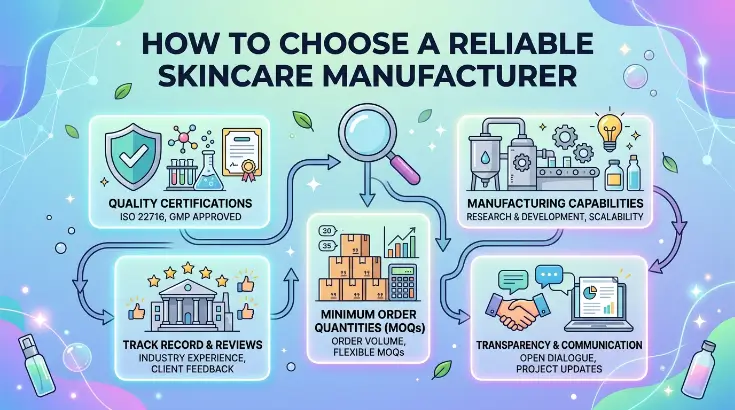
Launching a skincare brand involves much more than creating an attractive logo and choosing a memorable product name. Behind every successful beauty product is a reliable manufacturing process that ensures consistent quality, suitable formulations, professional packaging, and dependable production.
For new and established beauty businesses, choosing the right skincare manufacturer can have a significant impact on long-term growth. A good manufacturing partner can help turn an initial product concept into a commercially viable product, while the wrong supplier may create problems with quality, communication, production timelines, and costs.
Whether you are planning a small product launch or building a larger international beauty brand, there are several important factors to consider before selecting a skincare manufacturing partner.
Understand Your Product Requirements First
Before contacting manufacturers, clearly define what you want to produce.
Your requirements might include facial cleansers, moisturisers, serums, masks, sunscreen, body care products, or other personal-care products. You should also consider the type of formulation you want and the target customer for the product.
For example, a premium skincare brand may require sophisticated formulations and high-end packaging, while a startup may initially need smaller production quantities to test the market.
Having clear requirements makes it easier to compare manufacturers because you can ask each supplier the same questions about formulation, minimum order quantities, packaging, production capacity, and lead times.
Look for Private Label and OEM/ODM Capabilities
Different manufacturers offer different levels of support.
A private label manufacturer may provide ready-made formulations that can be produced under your brand name. This can be useful for businesses that want to launch products without developing an entirely new formula from scratch.
OEM and ODM services can provide greater flexibility. Depending on the manufacturer, these services may include custom formulation, product development, packaging selection, sampling, and production.
For businesses with a specific product concept, custom development can be particularly valuable because the final product can be designed around the brand’s target audience and positioning.
When comparing suppliers, ask exactly which services are included rather than assuming that every manufacturer offers the same level of customization.
Evaluate Formulation and Product Development
Formulation is one of the most important aspects of skincare manufacturing.
A manufacturer should be able to explain how product development works, from the initial concept through laboratory development and sample testing. You should also understand how revisions are handled if the first sample does not meet your expectations.
For a beauty brand, the formulation should align with the intended product claims, texture, fragrance preferences, packaging format, and target market.
It is also important to distinguish between marketing language and genuine formulation expertise. A supplier should be able to provide clear technical information and explain the development process in a professional manner.
Check Quality Control Procedures
Consistent quality is essential for any skincare brand. Customers expect products purchased today to perform consistently with products purchased several months later.
Ask potential manufacturers how they manage quality control throughout production. This can include raw material inspection, manufacturing controls, filling and packaging checks, finished-product testing, and batch management.
You can also ask whether the manufacturer maintains documentation for production batches and whether quality issues are recorded and investigated.
A well-organised quality-control system can reduce the risk of inconsistent products reaching customers and help a brand maintain its reputation as it grows.
Consider Certifications and Compliance
Skincare products are subject to regulatory requirements that can vary depending on the markets where they will be sold.
Before choosing a supplier, determine which markets you intend to enter and ask the manufacturer what compliance support and documentation they can provide.
A professional manufacturer should be able to explain the documentation available for its products and help clients understand the relevant requirements. However, brands should also carry out their own regulatory checks and, where necessary, work with qualified regulatory professionals.
This becomes especially important when selling internationally because different markets can have different requirements for cosmetic products, ingredients, labelling, safety documentation, and product claims.
Compare Minimum Order Quantities
Minimum order quantity, commonly called MOQ, is another major consideration for growing beauty businesses.
Large manufacturers may prefer substantial production runs because they can be more efficient from a manufacturing perspective. However, a high MOQ can create challenges for a startup that is still testing demand.
If too much inventory is produced before the product has been validated in the market, a brand may tie up significant amounts of capital in stock.
For this reason, ask each manufacturer about its MOQ for both standard and custom products. Also ask whether sample orders or pilot production runs are available.
A flexible manufacturing partner can be particularly useful during the early stages of a brand’s development.
Review Packaging Options
Packaging plays an important role in both product protection and brand identity.
Manufacturers may offer different bottle, jar, tube, pump, and container options. Some may also provide secondary packaging such as cartons, labels, and other branding elements.
When selecting packaging, consider more than appearance. The container should be suitable for the formulation and practical for the customer to use.
For example, certain formulations may require packaging that limits exposure to air or light. A manufacturer should be able to discuss packaging compatibility rather than simply offering whichever container looks attractive.
Packaging also affects shipping costs, storage requirements, and the overall retail presentation of the product.
Assess Production Capacity
A manufacturer that is suitable for a startup may not necessarily be suitable once the brand becomes successful.
Before entering a long-term relationship, consider the supplier’s production capacity and ability to scale.
Ask whether the manufacturer can increase production when demand grows and whether larger orders are subject to significantly different lead times.
Scalability is particularly important for brands that plan to sell through multiple retailers or expand into international markets.
A manufacturing partner should ideally be able to support the brand through different stages of growth rather than forcing the business to change suppliers as soon as order volumes increase.
Communication Matters
Manufacturing involves many details, so communication can have a major effect on the overall experience.
From product development and sampling to packaging and production schedules, there can be numerous decisions that require quick and accurate communication.
Pay attention to how a potential supplier responds during the initial enquiry. Are questions answered clearly? Are specifications explained properly? Are timelines realistic?
Good communication at the beginning can be a useful indication of how the relationship may work once production begins.
Research Potential Manufacturers
It is worth creating a shortlist rather than immediately choosing the first manufacturer you find.
Research companies based on their capabilities, experience, product categories, manufacturing services, quality systems, and target markets.
Businesses looking specifically for China skincare manufacturers can compare suppliers according to their product focus, OEM/ODM capabilities, private label services, minimum order quantities, and ability to support overseas brands. A useful starting point is this China skincare manufacturers resource, which brings together several manufacturers and explains what buyers should verify before making a decision.
The goal should not simply be to find the cheapest supplier. Instead, compare the complete value offered by each manufacturer.
A slightly higher manufacturing cost may be justified if the supplier provides better quality control, stronger development support, more reliable communication, and greater flexibility.
Request Samples Before Placing a Large Order
Samples provide an opportunity to evaluate the actual product before committing to significant production quantities.
Test the texture, fragrance, appearance, packaging, usability, and overall customer experience. If you are developing a custom formulation, compare the sample against the original product brief.
It can also be useful to collect feedback from a small group of appropriate testers before finalising the product.
Sampling does not eliminate every manufacturing risk, but it can help identify problems before they become expensive production issues.
Check the Manufacturer’s Development Support
Some brands need little more than a ready-made formula and branded packaging. Others require a much more involved development process.
If your business falls into the second category, look for a manufacturer that can support formulation adjustments, sample development, packaging coordination, and production planning.
For example, ZICAIL Beauty positions its manufacturing services around private label and OEM/ODM skincare projects, including custom formulation and packaging coordination. This type of support can be particularly useful for brands that need to move from an initial concept through sampling and eventually into production.
However, businesses should always confirm the exact services, MOQs, testing requirements, lead times, and documentation available for their individual project before placing an order.
Think About Long-Term Partnership
The best manufacturer is not necessarily the one offering the lowest initial quotation. For a growing beauty brand, a reliable long-term relationship can be much more valuable.
Consider whether the supplier can support future product launches, larger production runs, packaging changes, formulation updates, and expansion into new markets.
A strong manufacturing relationship can allow a brand to focus more of its resources on marketing, customer service, retail development, and product strategy while the manufacturing partner manages the production side.
Build a Clear Product Brief
Before starting production, prepare a detailed product brief.
The document should explain the product concept, target customer, desired texture, fragrance preferences, packaging requirements, product size, target market, expected positioning, and any other important specifications.
A clear brief reduces misunderstandings between the brand and manufacturer. It also gives the supplier a better understanding of what the final product should achieve.
For custom products, the brief can become an important reference throughout the development and sampling stages.
Compare Suppliers Before Making a Final Decision
Instead of choosing a manufacturer based on one quotation, compare at least several potential suppliers.
Create a simple comparison covering formulation capabilities, MOQ, sample fees, production lead time, packaging options, quality control, communication, compliance documentation, and scalability.
Price should certainly be considered, but it should not be the only deciding factor.
A manufacturer that offers a lower unit price but has inconsistent communication or limited development support may ultimately cost more through delays, revisions, or quality problems.
Final Thoughts
Choosing a skincare manufacturer is one of the most important decisions a beauty brand can make. Product quality, packaging, production reliability, compliance, communication, and scalability can all influence the success of a new product.
Start by defining your requirements, then compare manufacturers according to their formulation capabilities, quality-control processes, MOQs, packaging options, production capacity, and support services.
Most importantly, take time to research potential suppliers and request samples before committing to a large production order.
With the right manufacturing partner, a skincare business can move from an initial product idea to a professional product line while building the foundations needed for sustainable growth. A carefully selected supplier can become more than a production company—it can become a valuable long-term partner as the beauty brand expands into new products and markets.