
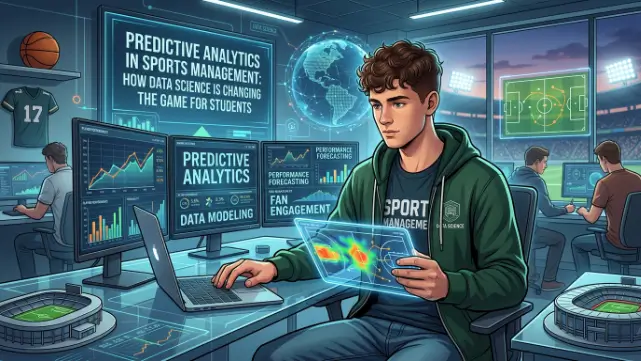
The roar of the crowd and the smell of fresh-cut grass are still part of the magic of sports, but today, the real action often happens behind a glowing computer screen. If you look at the front office of any major team in the MLB, NBA, or NFL, you won’t just find former players and scouts. You will find mathematicians, coders, and data analysts. Predictive analytics has moved from a “cool experiment” to the heartbeat of the industry. For students entering this field, the playbook has changed forever.
The Shift from Gut Instinct to Big Data
For decades, sports management relied on the “eye test.” A scout would watch a player and decide if they had the “heart” or the “swing” to make it big. While human intuition still matters, data science now provides a layer of certainty that was never possible before. Teams use complex algorithms to predict everything from player injuries to ticket sales.
For a student today, understanding the business of sports means understanding the flow of information. It is no longer enough to know the rules of the game; you have to know how to interpret the numbers. This shift is creating a massive demand for professionals who can bridge the gap between traditional management and high-level technical analysis.
Why Predictive Modeling is the New MVP
Predictive modeling uses historical data to forecast future outcomes. In sports, this applies to two main areas: on-field performance and off-field business operations.
On the field, teams use data to determine which player is most likely to hit a home run against a specific left-handed pitcher in a night game. Off the field, teams use analytics to predict fan behavior. They can see which promotional giveaways will fill the stadium or which social media posts will drive the most engagement. When you are tasked with a complex project on these topics, you might feel overwhelmed and think, “I need someone to do my assignment so I can focus on the actual coding.” That is a common feeling because the bar for technical accuracy in sports management is higher than it has ever been.
The Technical Toolkit: Python, R, and Beyond
If you want to work in a modern front office, you need to speak the right languages. Python and R have become the industry standards for data manipulation. These tools allow analysts to scrape data from thousands of games and turn it into actionable insights.
Beyond just general data science, web-based tools and database management are crucial. Many sports analytics platforms are built using PHP to manage massive databases of player stats. If you are struggling to build a backend for a sports-tracking app, getting expert php assignment help can ensure your code is efficient and secure. Mastering these technical skills early gives students a massive advantage in a competitive job market where “tech-savvy” is a baseline requirement.
Enhancing the Fan Experience Through Data
Data science isn’t just about winning games; it’s about keeping the lights on. The “Fan Experience” is a huge part of sports management. Teams now use “sentiment analysis” to see how fans feel about a trade or a ticket price hike in real-time. By analyzing data from wearable tech and mobile apps, teams can even predict when a fan is likely to leave their seat to buy a hot dog, allowing them to optimize concession stand staffing.
For students, this means careers are opening up in areas that didn’t exist ten years ago. You could be a “Director of Fan Chemistry” or a “Lead Revenue Analyst.” The opportunities are vast, but they require a deep comfort level with numbers and digital strategy.
Preventing Injuries Before They Happen
One of the most valuable uses of predictive analytics is “preventative maintenance” for human beings. Athletes now wear GPS trackers and heart rate monitors during every practice. This data is fed into models that flag when a player is reaching a “red zone” of fatigue.
By predicting when a player is at a high risk for an ACL tear or a hamstring strain, coaches can adjust training loads. This saves teams millions of dollars in lost contracts and keeps the best players on the field. Students studying sports medicine or management must now be familiar with these biometric data streams to be effective in their future roles.
Preparing for a Career in the New Era
So, how does a student prepare for this high-tech world?
- Embrace Mathematics: Statistics is the foundation of everything in sports today.
- Learn to Code: Pick up a language like Python or SQL. These are your tools for digging through data.
- Understand the Business: Data is useless if you don’t know how it impacts the bottom line of a sports franchise.
- Stay Curious: The world of tech moves fast. What works in 2026 might be replaced by 2028.
The competition for these jobs is fierce. Every sports-loving kid with a laptop wants to be the next “Moneyball” genius. To stand out, your work needs to be polished, your data needs to be clean, and your insights need to be sharp.
Conclusion
The integration of predictive analytics into sports management is far from a passing trend; it is the fundamental evolution of the industry. For students today, the message is clear: the ability to interpret data is just as vital as understanding the mechanics of the game. As teams continue to invest heavily in machine learning and real-time biometric tracking, the demand for professionals who can turn raw numbers into winning strategies will only grow.
By bridging the gap between traditional sports knowledge and technical proficiency, you position yourself at the forefront of this revolution. Whether you are optimizing a team’s defensive shift or predicting the next big trend in fan engagement, your data-driven insights will be the driving force behind the sports world’s biggest successes. The future of sports belongs to those who can master the data today, ensuring that every decision made in the front office is backed by the power of predictive intelligence. Embracing these tools now is the surest way to secure your spot in the front office of tomorrow.
 Hamza
Hamza
 Rizwan Aslam
[…] software provides essential features like data visualization, predictive analytics, and real-time reporting. These tools serve financial analysts and accountants by offering insights […]