
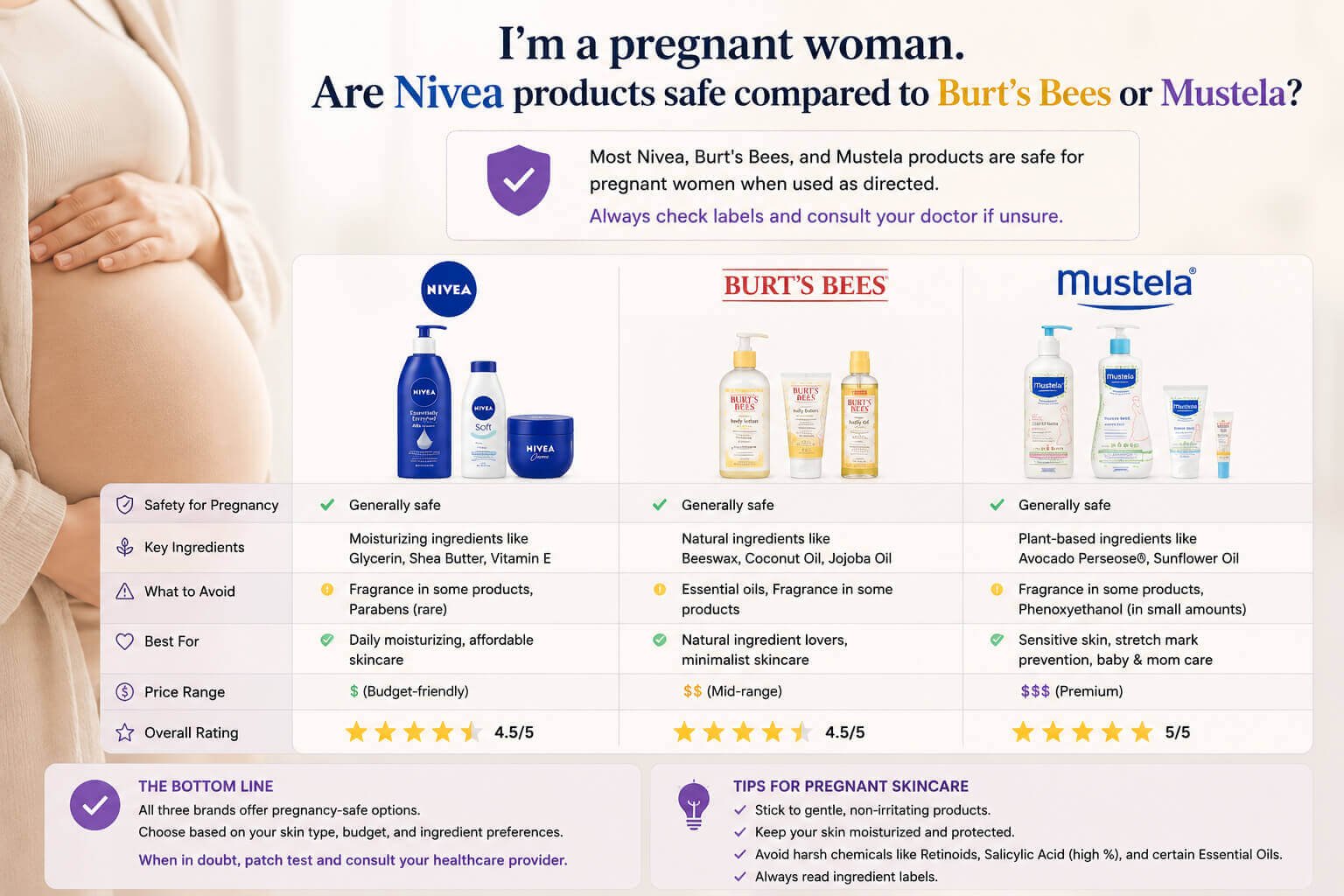
Pregnancy changes how many women think about skincare. A moisturizer you used for years suddenly feels questionable once you start reading ingredient warnings online. That is why searches like “I’m a pregnant woman. Are Nivea products safe compared to Burt’s Bees or Mustela?” have increased so sharply. Most expecting mothers are not looking for luxury skincare advice. They want one clear answer: Will this product harm my baby?
The short answer is this: many basic Nivea moisturizers are generally considered low risk during pregnancy, but safety depends on the exact formula and ingredients. Burt’s Bees and Mustela are also commonly used during pregnancy, though each brand has strengths and limitations. Mustela specifically designs several products for pregnancy and postpartum care, while Burt’s Bees focuses heavily on naturally derived ingredients. None of these brands is universally “perfect” or universally unsafe.
The safest approach during pregnancy is to evaluate products ingredient-by-ingredient instead of trusting marketing labels like “natural,” “clean,” or “dermatologist tested.” Some ingredients deserve extra caution during pregnancy, especially retinoids, hydroquinone, and certain high-strength acne treatments.
This guide compares Nivea, Burt’s Bees, and Mustela using current dermatology guidance, pregnancy skincare recommendations, and ingredient safety research to help you make informed decisions confidently.
Why Pregnancy Changes Your Skincare Needs
Pregnancy affects far more than your growing belly. Hormonal changes alter oil production, skin sensitivity, pigmentation, hydration levels, and immune responses. Many women who never reacted to skincare before suddenly develop:
- Dry patches
- Irritation
- Redness
- Melasma
- Acne flare-ups
- Increased fragrance sensitivity
At the same time, pregnant women become more cautious about what absorbs through the skin. That concern is understandable because some topical ingredients can enter the bloodstream in small amounts.
The challenge is that social media often turns reasonable caution into panic. Online forums frequently label ordinary moisturizers as “toxic” without evidence. That creates confusion and unnecessary fear.
According to the American Academy of Dermatology, most standard moisturizers are considered low risk during pregnancy unless they contain ingredients known to raise concerns, such as prescription-strength retinoids. The focus should be on identifying problematic active ingredients rather than avoiding every mainstream skincare brand altogether.
This is where comparing Nivea, Burt’s Bees, and Mustela becomes useful because these brands approach skincare differently:
- Nivea focuses on traditional moisturizing formulas
- Burt’s Bees emphasizes naturally derived ingredients
- Mustela develops many products specifically for mothers and babies
Understanding those differences matters more than simply choosing whichever brand appears “cleanest.”
Which Brand Is Safest During Pregnancy?
If you want the shortest evidence-based answer:
| Brand | Pregnancy Safety Overview | Best Known For |
|---|---|---|
| Nivea | Many classic moisturizers are generally low risk | Deep hydration and affordability |
| Burt’s Bees | Usually pregnancy-friendly, but essential oils may irritate sensitive skin | Natural ingredient focus |
| Mustela | Often preferred for pregnancy-specific skincare | Stretch mark and maternity products |
No skincare brand is automatically safe or unsafe as a whole. Product formulas matter far more than brand reputation.
For example:
- Basic Nivea Creme is usually considered low concern because it mainly contains moisturizers and emollients.
- Some anti-aging products from any brand may contain ingredients pregnant women should avoid.
- Natural ingredients in Burt’s Bees products can still trigger irritation during pregnancy.
- Mustela’s maternity line is specifically formulated with pregnancy use in mind, which gives it an advantage for stretch mark prevention and sensitive pregnancy skin.
Women with high-risk pregnancies, severe eczema, or prescription skincare treatments should still consult their OB-GYN or dermatologist before changing routines.
Ingredients Pregnant Women Usually Avoid in Skincare
The biggest mistake pregnant women make is focusing only on brand names instead of active ingredients. A “natural” product can still irritate pregnancy skin, while a mainstream moisturizer may be perfectly acceptable.
These ingredients typically deserve the most caution during pregnancy.
Retinoids
Retinoids are vitamin A derivatives commonly used for:
- Acne
- Wrinkles
- Anti-aging
- Skin renewal
Examples include:
- Retinol
- Retinyl palmitate
- Tretinoin
- Adapalene
Oral isotretinoin is strongly linked to birth defects, which is why dermatologists recommend avoiding topical retinoids during pregnancy as a precaution.
This matters because some anti-aging moisturizers from mainstream brands may contain vitamin A derivatives even if the packaging does not clearly say “retinoid.”
Hydroquinone
Hydroquinone is used for skin lightening and pigmentation treatment. Studies suggest it has relatively high absorption rates through the skin compared to many cosmetic ingredients.
Pregnant women are usually advised to avoid it unless specifically instructed by a physician.
High-Strength Salicylic Acid
Low amounts found in face cleansers are generally viewed differently from high-dose peels or concentrated acne treatments.
Most OB-GYNs recommend limiting high-strength salicylic acid products during pregnancy.
Certain Essential Oils
This surprises many people because “natural” marketing creates the impression that plant-based ingredients are automatically safer.
Some essential oils may:
- Trigger headaches
- Increase irritation
- Cause nausea
- Worsen pregnancy sensitivity
That does not mean all essential oils are dangerous. It means pregnant skin often reacts differently than usual.
Are Nivea Products Safe During Pregnancy?
Many standard Nivea moisturizers are generally considered pregnancy-compatible because they focus mainly on hydration rather than aggressive active ingredients.
Popular products like:
- Nivea Creme (blue tin)
- Nivea Soft
- Nivea Essentially Enriched Body Lotion
primarily contain:
- Emollients
- Humectants
- Occlusives
- Fragrance
These ingredients mainly help reduce dryness and protect the skin barrier.
The Biggest Concern With Nivea During Pregnancy
The most common issue is not toxicity. It is fragrance sensitivity.
Pregnancy can dramatically increase sensitivity to:
- Perfumes
- Scented lotions
- Preservatives
Women who tolerated heavily fragranced creams before pregnancy sometimes develop:
- Nausea
- Skin irritation
- Headaches
Nivea products are often more fragranced than Mustela’s maternity-focused skincare.
Nivea Products That Usually Raise More Questions
Pregnant women should carefully review:
- Anti-aging creams
- Q10 formulas
- Acne products
- Skin brightening treatments
Not because Nivea is unsafe overall, but because targeted treatment products are more likely to contain stronger active ingredients.
The safest approach is simple:
Check the ingredient list instead of assuming every product under the same brand is identical.
Is Burt’s Bees Safer During Pregnancy?
Burt’s Bees has built its reputation around naturally derived ingredients, which makes many pregnant women feel more comfortable using it.
Popular pregnancy-related products include:
- Burt’s Bees Mama Bee Belly Butter
- Burt’s Bees body lotions
- Burt’s Bees lip balms
These products often avoid harsh acne ingredients and prescription-style actives.
The “Natural Means Safe” Myth
This is where many online discussions become misleading.
Natural ingredients can still:
- Irritate sensitive skin
- Trigger allergies
- Cause fragrance reactions
Essential oils are the biggest example.
Some Burt’s Bees products contain:
- Peppermint oil
- Citrus oils
- Botanical extracts
- Fragrance blends
Pregnancy hormones can make these ingredients feel much stronger than usual.
Where Burt’s Bees Performs Well
Burt’s Bees is often appreciated for:
- Simpler ingredient lists
- Moisturizing plant oils
- Gentle body care products
- Pregnancy-focused body butters
Women trying to avoid heavily synthetic-feeling products often prefer Burt’s Bees over Nivea because the textures and scents feel lighter and more natural.
Still, ingredient review remains important because not every product in a “natural” line is automatically ideal for pregnancy.
Why Many Pregnant Women Prefer Mustela
Mustela has become one of the most recognized skincare brands for mothers and babies because many of its products are specifically formulated for pregnancy and postpartum care.
Its maternity line includes products designed for:
- Stretch marks
- Dryness
- Skin elasticity
- Sensitive pregnancy skin
That targeted approach gives Mustela a major advantage in pregnancy skincare discussions.
Mustela Stretch Mark Creams
Products like Mustela Stretch Marks Cream are frequently recommended because they are designed specifically for expecting mothers.
These products often emphasize:
- Dermatologist testing
- Pregnancy compatibility
- Fragrance sensitivity awareness
- Hydration support
Many pregnant women feel more confident using products marketed directly toward maternity needs because the brand already anticipates common pregnancy concerns.
Does Mustela Automatically Mean Safer?
Not automatically.
Even pregnancy-focused skincare should still be reviewed individually. Marketing language alone should never replace ingredient awareness.
However, Mustela’s advantage is that the company intentionally formulates many products around:
- Pregnancy use
- Infant exposure
- Sensitive skin concerns
That usually makes its maternity line feel more reassuring to expecting mothers compared to general skincare brands.
Nivea vs Burt’s Bees vs Mustela: Which Is Better During Pregnancy?
| Feature | Nivea | Burt’s Bees | Mustela |
|---|---|---|---|
| Main Focus | Traditional moisturization | Natural-inspired skincare | Pregnancy and baby care |
| Fragrance Level | Often stronger | Moderate botanical scents | Usually softer maternity-focused scents |
| Pregnancy-Specific Products | Limited | Some | Extensive |
| Stretch Mark Products | Few | Some | Strong specialty focus |
| Sensitive Skin Appeal | Moderate | Moderate | Strong |
| Price Range | Affordable | Mid-range | Mid to premium |
| Ingredient Simplicity | Moderate | Often simpler | Pregnancy-targeted formulations |
The “best” choice depends on what matters most to you.
Choose:
- Nivea, if you want rich hydration and already tolerate fragranced creams well.
- Burt’s Bees, if you prefer naturally derived ingredients and lighter botanical skincare.
- Mustela, if you want products specifically designed for pregnancy and postpartum use.
What Dermatologists Usually Recommend During Pregnancy
Most dermatologists focus on minimizing unnecessary risk rather than creating fear around every cosmetic ingredient.
The general recommendations usually include:
- Avoid retinoids
- Avoid hydroquinone
- Limit aggressive acne treatments
- Prioritize gentle moisturizers
- Reduce irritation triggers
- Protect the skin barrier
That advice matters because pregnancy itself already increases inflammation and skin sensitivity.
A simple moisturizer with:
- Glycerin
- Shea butter
- Hyaluronic acid
- Petrolatum
- CeramidesIt
is often considered more useful during pregnancy than complicated anti-aging formulas.
This is one reason many women temporarily simplify their skincare routines during pregnancy.
Common Mistakes Pregnant Women Make With Skincare
Throwing Away Every Product Immediately
Many women panic after reading social media warnings and discard perfectly reasonable moisturizers unnecessarily.
Most basic body lotions are not considered high-risk products.
Trusting TikTok More Than Medical Sources
Viral skincare videos frequently confuse:
- Theoretical risk
- Proven risk
- Irritation risk
- Toxicity risk
These are not the same thing.
Assuming Expensive Means Safer
Premium pregnancy branding does not automatically guarantee safer ingredients.
Ignoring Fragrance Sensitivity
Pregnancy changes scent tolerance dramatically. A lotion that once smelled comforting may suddenly trigger nausea.
How to Check If a Skincare Product Is Pregnancy Safe
Instead of relying only on brand reputation, use this simple process.
Step 1: Read the Active Ingredients
Look for:
- Retinoids
- Hydroquinone
- High-strength salicylic acid
Step 2: Consider Skin Sensitivity
Ask yourself:
- Has pregnancy made your skin reactive?
- Do fragrances trigger headaches?
- Are essential oils irritating your skin?
Step 3: Keep Your Routine Simple
Pregnancy is rarely the best time to experiment with aggressive skincare routines.
Step 4: Ask Your Doctor if Unsure
This is especially important if:
- You have a high-risk pregnancy
- You use prescription skincare
- You have severe acne or eczema
FAQ
Is Nivea Creme safe during pregnancy?
Many pregnant women continue using classic Nivea Creme without issues because it mainly functions as a moisturizer. The primary concern is usually fragrance sensitivity rather than dangerous active ingredients. Women with sensitive skin may still prefer fragrance-light alternatives.
Which is safer during pregnancy: Nivea or Mustela?
Mustela is often preferred for pregnancy skincare because it offers maternity-specific formulations. However, many basic Nivea moisturizers are also considered low risk. The safest option depends on the exact product ingredients and your skin sensitivity.
Are Burt’s Bees products safe for pregnant women?
Many Burt’s Bees products are commonly used during pregnancy, especially body butters and moisturizers. However, some formulas contain essential oils or botanical fragrances that may irritate sensitive pregnancy skin.
What skincare ingredients should pregnant women avoid?
Pregnant women are commonly advised to avoid:
- Retinoids
- Hydroquinone
- High-strength salicylic acid
- Certain prescription acne treatments
Always discuss prescription skincare with your physician.
Is fragrance dangerous during pregnancy?
Fragrance is not automatically dangerous, but pregnancy often increases sensitivity to scents. Some women develop nausea, headaches, or irritation from fragranced skincare products during pregnancy.
Should pregnant women switch to “natural” skincare only?
Not necessarily. Natural ingredients can still cause irritation or allergic reactions. Product safety depends more on the full ingredient formula than marketing terms like “natural” or “clean.”
Final Thoughts
Most pregnant women do not need to completely replace every skincare product they own. The safest and most realistic approach is to focus on ingredient awareness instead of fear-based marketing.
Nivea, Burt’s Bees, and Mustela all offer products that many pregnant women use successfully. The key differences involve:
- Fragrance levels
- Ingredient philosophy
- Pregnancy-specific formulations
- Skin sensitivity support
Mustela often feels the most pregnancy-focused, Burt’s Bees appeals to women seeking naturally derived ingredients, and Nivea remains a widely used moisturizing option for dry skin.
If you are unsure about a specific product, review the ingredient list carefully and discuss concerns with your OB-GYN or dermatologist. Pregnancy skincare should feel reassuring, not stressful.
 Kaif
Kaif
 Hamza
Hamza